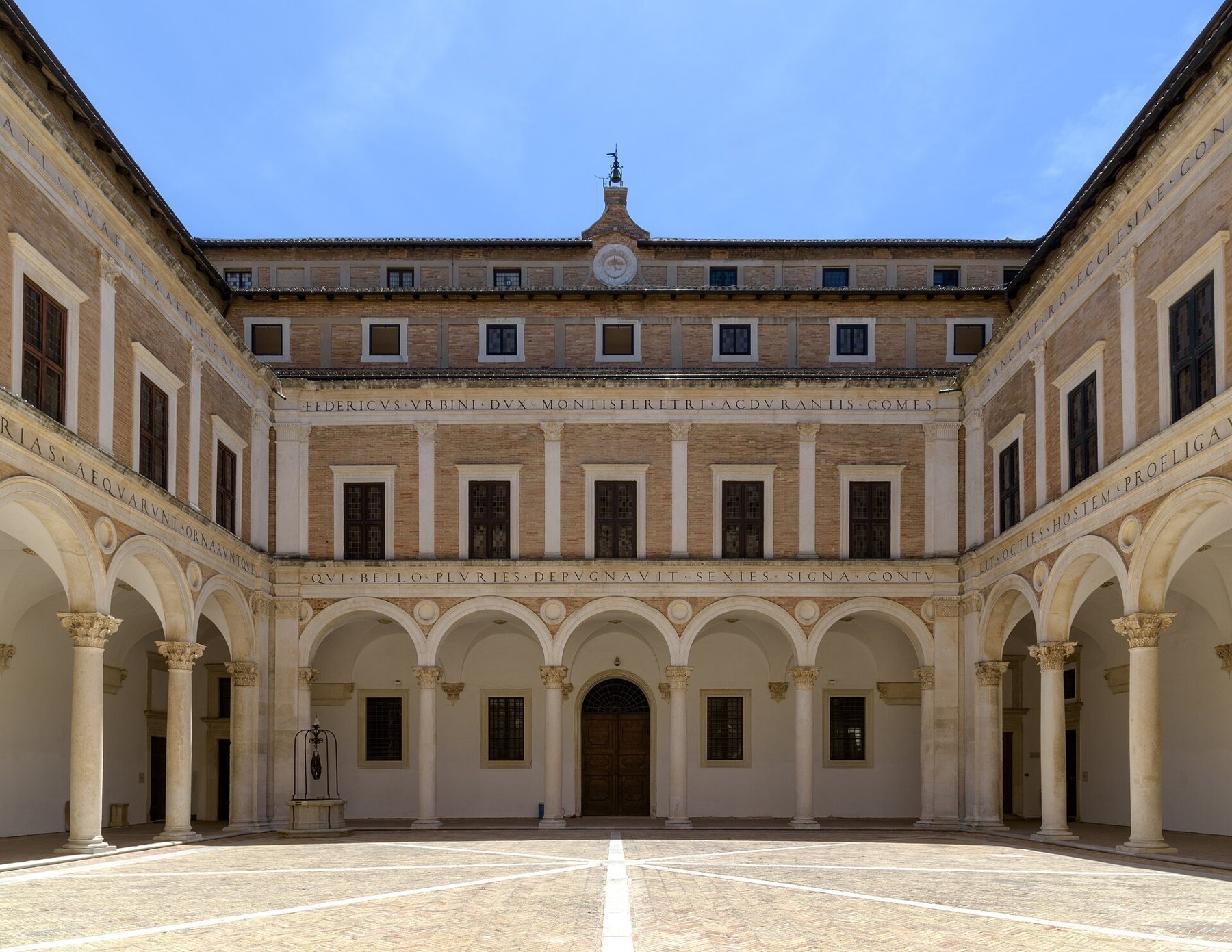
Federico da Montefeltro was one of the most successful professional soldiers of fifteenth-century Italy, a condottiere who sold his services to popes and princes and became Duke of Urbino. He spent his fortune on building and learning, and from the 1460s he turned the family's hilltop residence into one of the most admired palaces of the Renaissance. Baldassare Castiglione, who wrote about the court of Urbino in the following century, described it as a city in the form of a palace.
Today the palace houses the Galleria Nazionale delle Marche, one of the finest collections of Renaissance painting in Italy. Urbino's historic centre is a UNESCO World Heritage Site. The palace is number 39 on this list.
The towers on the western front
The best view of the palace is from the west, from the road that climbs to the town. From here, the palace rises above the valley with a facade between two slender towers with conical roofs, the Torricini, framing three stacked loggias, open balconies facing the hills. It is one of the most beautiful facades of the Renaissance, and it was designed to be seen from outside the walls, presenting the duke's palace to anyone approaching the town.
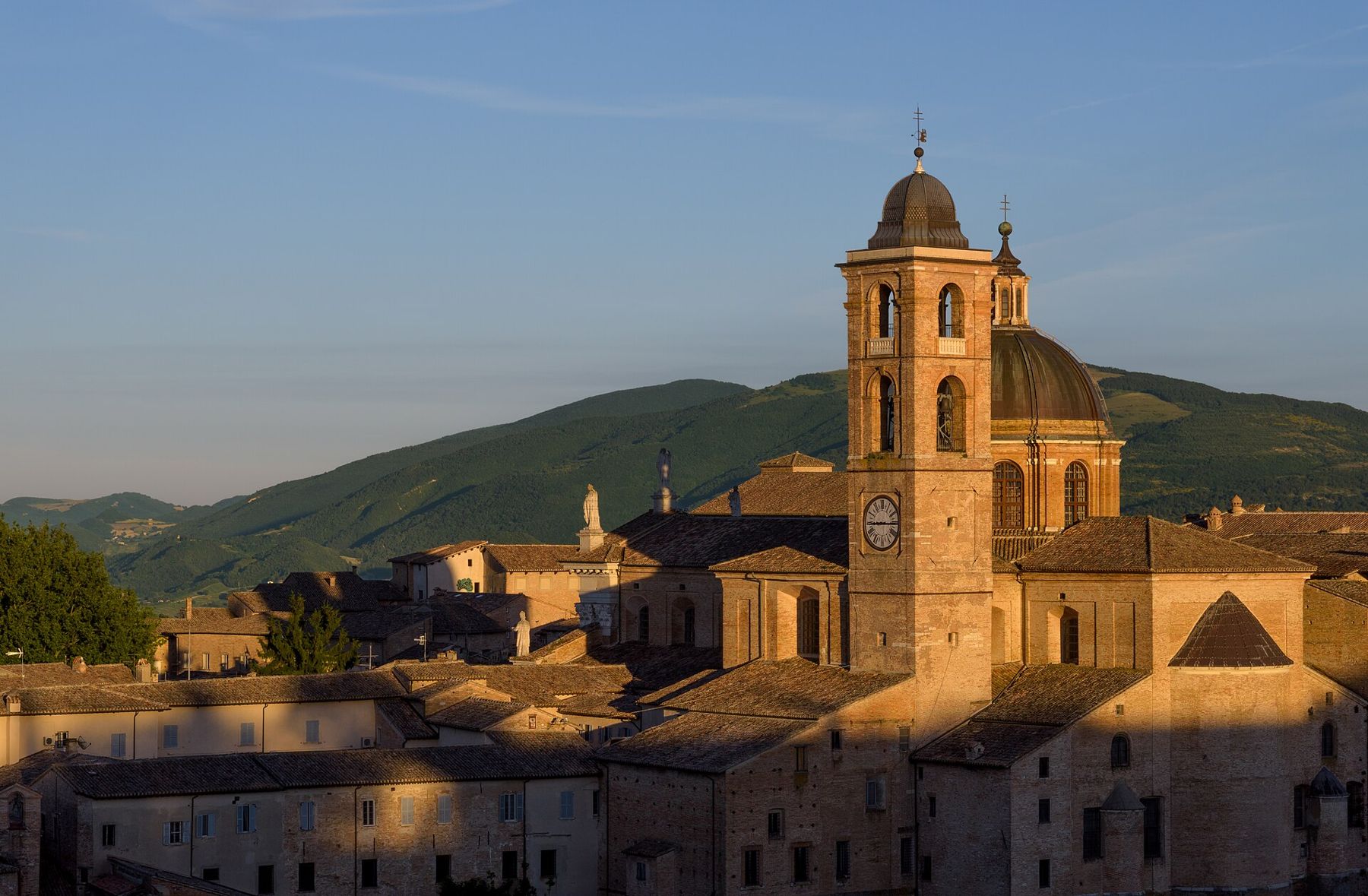
From the town side, the palace looks quite different: long brick facades on a square beside the cathedral, with fine stone doorways and windows. The architects who worked on it, first Luciano Laurana and then Francesco di Giorgio Martini, adapted the design to the steep hilltop, and the building follows the shape of the ground.
The courtyard of honour
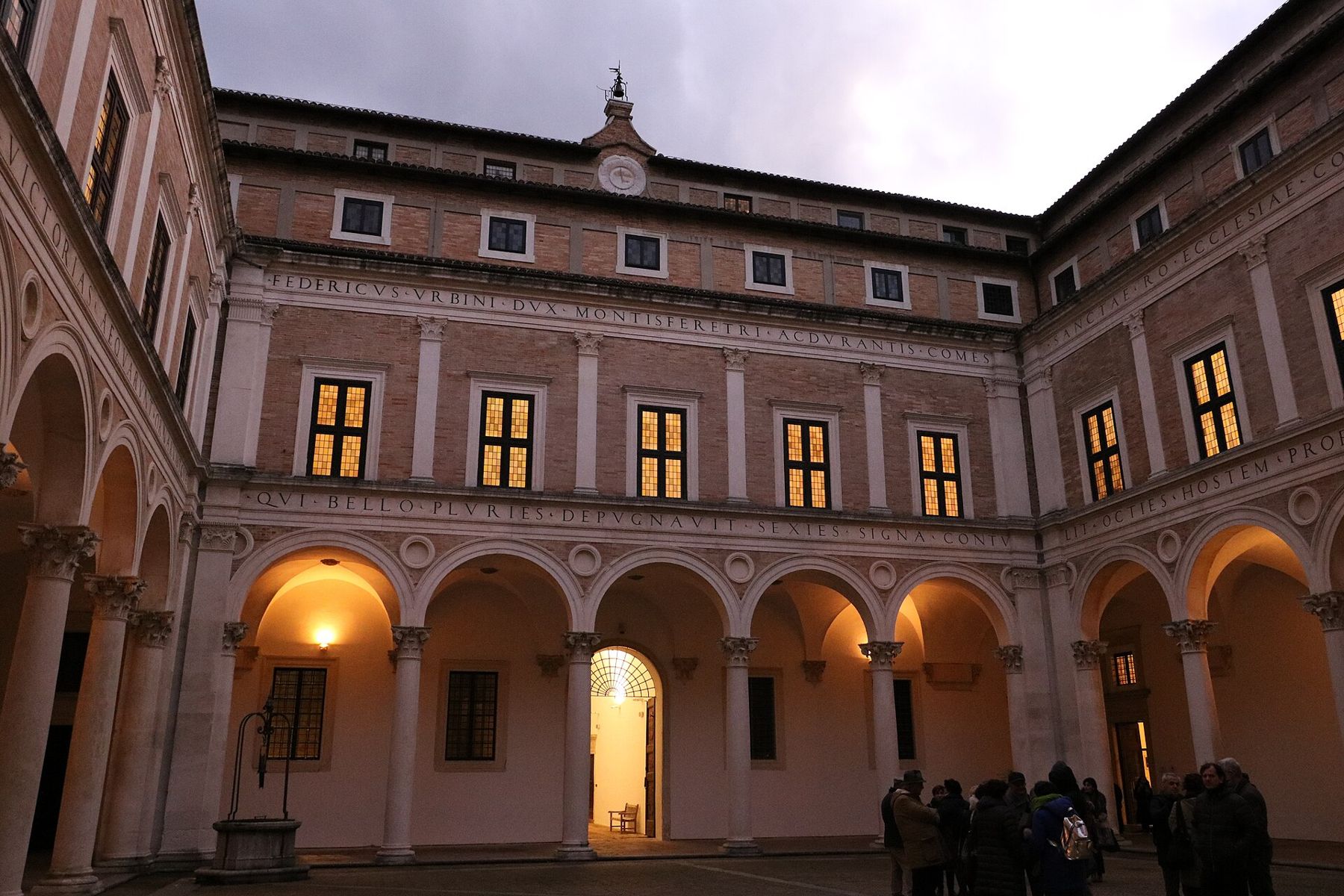
Inside, the main courtyard is one of the masterpieces of Renaissance architecture. Its arcades of light, round arches on slender columns, with a frieze of inscriptions in honour of the duke running around the top, create a calm, perfectly proportioned space. The stone is pale and the brick warm, and in the afternoon sun the courtyard glows. The proportions were worked out with great care, and architects have studied the courtyard for centuries as a model of harmony; it is the kind of space that makes people lower their voices. It was designed as the centre of the palace, linking the public rooms, the apartments and the services.
A grand staircase leads up to the main floor, where the duke's apartments and the state rooms are now the galleries of the museum.
The studiolo
The most famous room in the palace is the duke's studiolo, his small private study. Its walls are covered to above head height with intarsia, panels of inlaid wood that create illusions of cupboards with half-open doors, shelves of books, musical instruments, scientific instruments, armour and a squirrel eating a nut. The illusion is so convincing that you want to reach out and take a book from the shelf. Above the panelling, portraits of famous men of learning once hung in two rows; some remain, others are now in the Louvre.
The studiolo is a tiny room, and visitors pass through in small numbers. It is a portrait of the ideal Renaissance prince: a soldier who was also a reader, a musician and a student of science.
It is a portrait of the ideal Renaissance prince: a soldier who was also a reader, a musician and a student of science.
The Galleria Nazionale
The collection includes some of the most famous paintings of the fifteenth and sixteenth centuries. Piero della Francesca's Flagellation of Christ is a small, mysterious picture in which the scene of Christ's torture is set in the background, while three enigmatic figures stand in the foreground; its meaning is still debated. His Madonna of Senigallia is quieter and equally beautiful. Raphael, who was born in Urbino, is represented by a portrait of a woman known as La Muta, the silent one.
The gallery also holds works by Paolo Uccello, Luca Signorelli and Titian, and a portrait of the duke and his son by a painter of the court, with the duke reading in full armour, a summary of his two lives in one image. Look also for the panel known as the Ideal City, an anonymous painting of a perfect Renaissance square with a round temple at its centre and no people, a vision of architecture as order and harmony.
A palace built for a court of learning
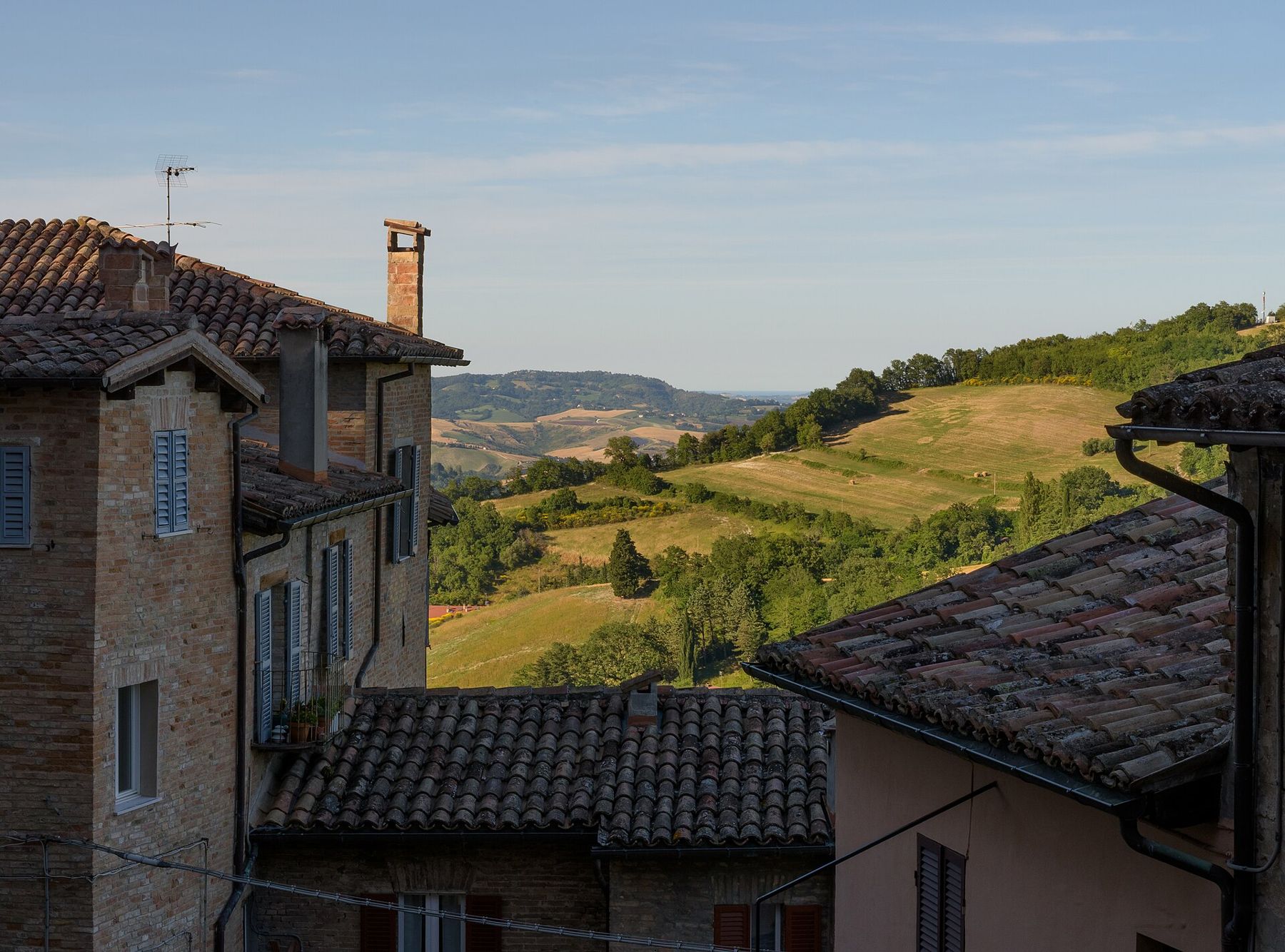
The town itself rewards a slow walk. Steep lanes of brick climb between the two hills, and the university keeps the streets lively for much of the year. The house where Raphael was born stands a short climb above the main square, and the walls on the northern side give long views over the Marche hills.
Federico's court was famous for its library, one of the finest in Europe, with hundreds of manuscripts copied and bound for the duke. The books were later taken to Rome, and they are now in the Vatican Library, but the room that held them can still be seen. Scholars, mathematicians, architects and painters came to Urbino, and the palace was designed with spaces for study, music and conversation as well as for ceremony.
Below the main floors, the palace had a remarkable set of service rooms, including kitchens, stables, ice stores, laundries and a system for collecting rainwater, all built into the hillside. Some of these underground rooms can be visited, and they show how carefully the palace was planned to work as a self-contained community.
The duke himself is well known from his portraits, almost always shown in left profile because he lost his right eye and part of his nose in a tournament. His son Guidobaldo continued the court, and it was in his time that Castiglione set his famous book about the ideal courtier in these rooms.
Urbino around the palace
Urbino is a small hill town of steep streets and brick houses, with a large university that keeps it lively. Raphael's birthplace, a house on one of the main streets, is open as a museum, with rooms furnished as a painter's home of the period and an early fresco attributed to the young artist. The steep street that climbs to it from the main square is one of the best walks in town. From the fortress on the hill opposite the palace, the view back across the rooftops to the Torricini is the best in town.
Urbino is not on the railway. Buses run from Pesaro on the Adriatic coast, about an hour away. Allow two to three hours for the palace, and give yourself time for the town. From here, the list heads south to the Bourbon palace at Caserta; for a court of the same period, see Mantua. Opening hours, prices and exhibitions change, so check them for Urbino before you go.