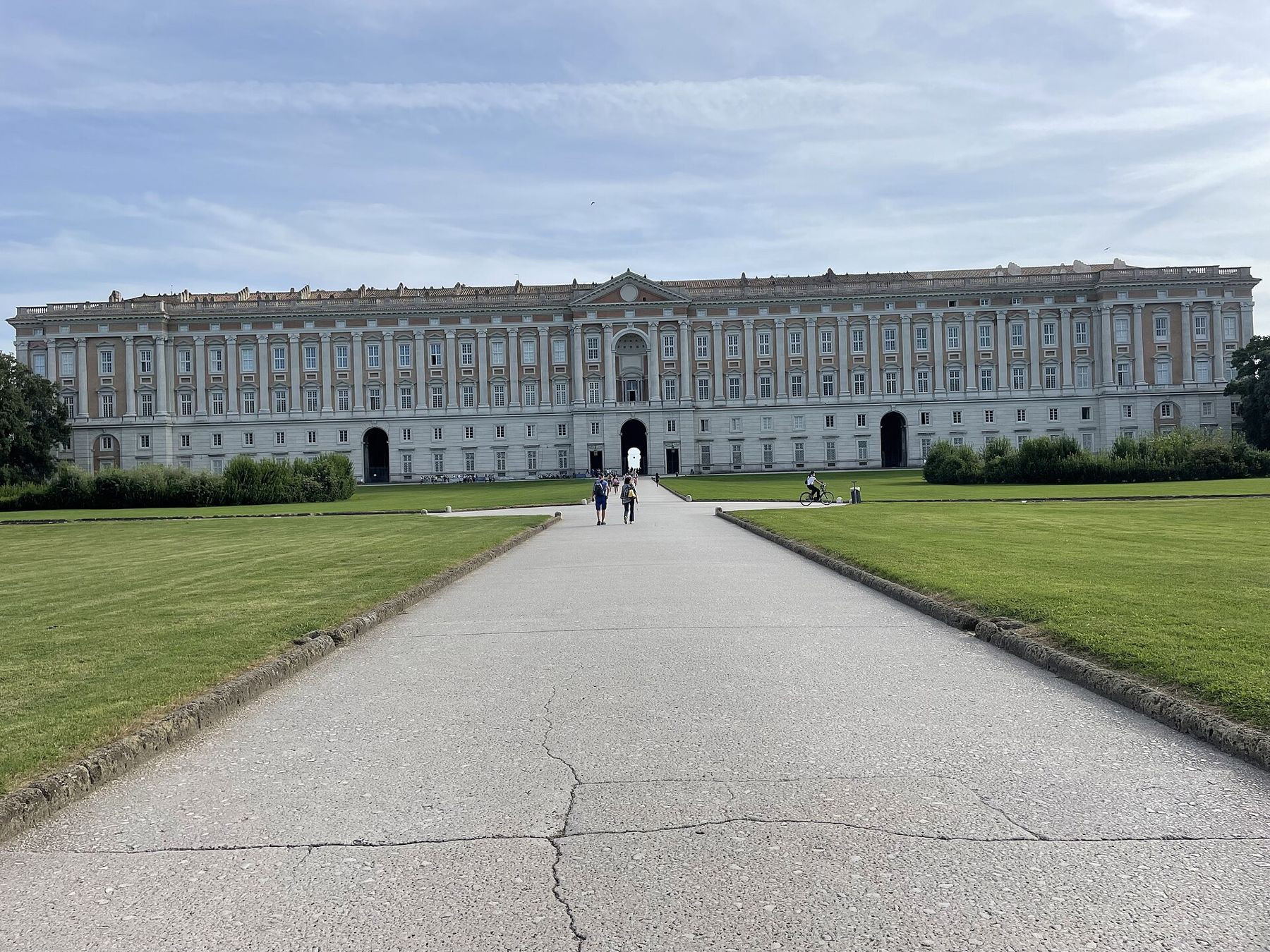
In the mid-eighteenth century, Charles of Bourbon, King of Naples, decided to build a new royal palace away from the crowded capital, in the countryside at Caserta, north of Naples. He commissioned the architect Luigi Vanvitelli, and work began in 1752. The result was one of the largest palaces in Europe, with some twelve hundred rooms arranged around four great courtyards, and a park stretching for three kilometres towards the hills. It was meant to rival Versailles, and in scale it does.
The palace, its park and the aqueduct that feeds the fountains are together a UNESCO World Heritage Site. It is number 43 on this list.
Arrival and the great vestibule
The palace stands directly opposite the railway station at Caserta, and the first sight of it, a vast facade with hundreds of windows, is overwhelming. A central gateway leads into a long vaulted passage that runs through the whole building, with views through to the park beyond. At the crossing of the passages, an octagonal vestibule gives views into all four courtyards at once, a theatrical device Vanvitelli used to show off the scale of his plan.
From the vestibule rises the grand staircase, one of the most spectacular in Italy. A single wide flight of steps, flanked by marble lions, rises to a landing where it splits into two flights climbing to the upper vestibule. The walls are faced with coloured marbles, and the double vault above is designed so that musicians could play in a hidden gallery. Climbing the staircase was meant to be an experience in itself, preparing visitors for an audience with the king. Stop on the landing and look back down: the view of the steps, the lions and the light from the vestibule below is the one most visitors remember. Many people climb it twice.
The royal apartments and the chapel
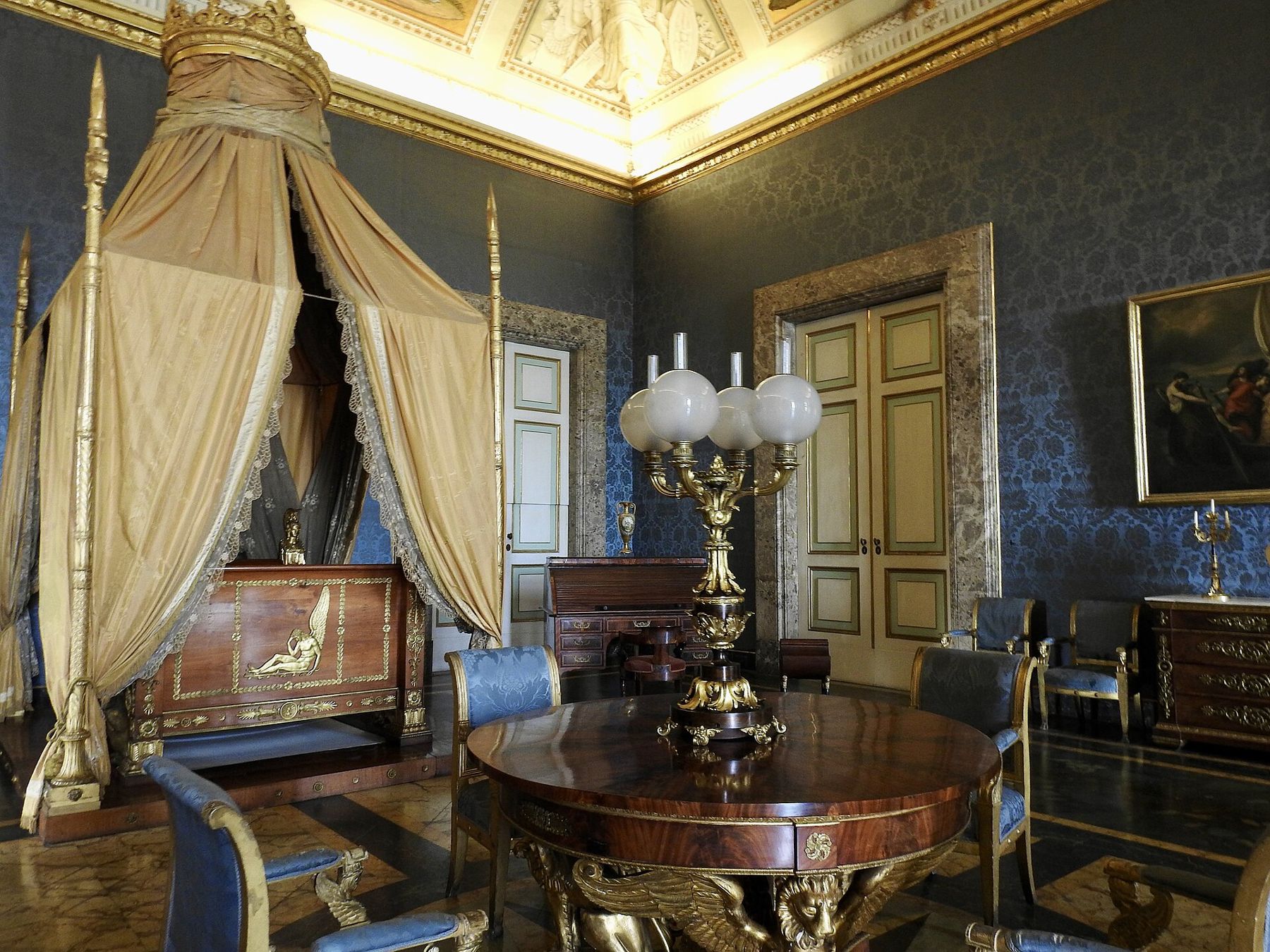
The upper floor holds the royal apartments, a long sequence of state rooms decorated from the late eighteenth to the nineteenth century. The earlier rooms are in a rich late baroque and neoclassical style, with frescoed ceilings, silk walls, gilded furniture and chandeliers. Later rooms, decorated for the Bourbon kings of the nineteenth century, are lighter and more domestic. The throne room is one of the largest and grandest.
Off the upper vestibule, the palace chapel was inspired by the chapel at Versailles, with a colonnade of paired columns and a gilded interior. It was damaged by bombing in the Second World War and has been restored.
The park and its fountains
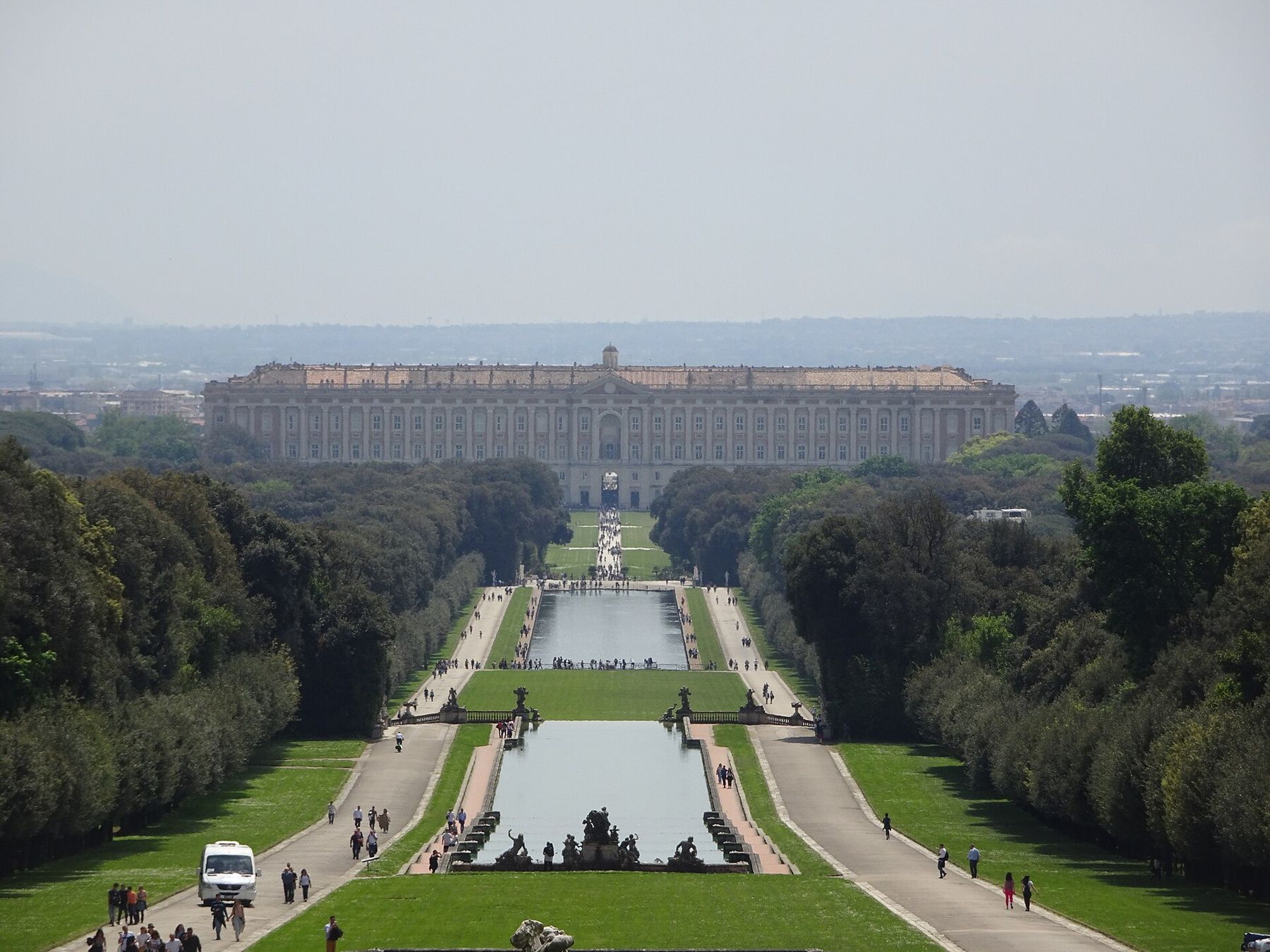
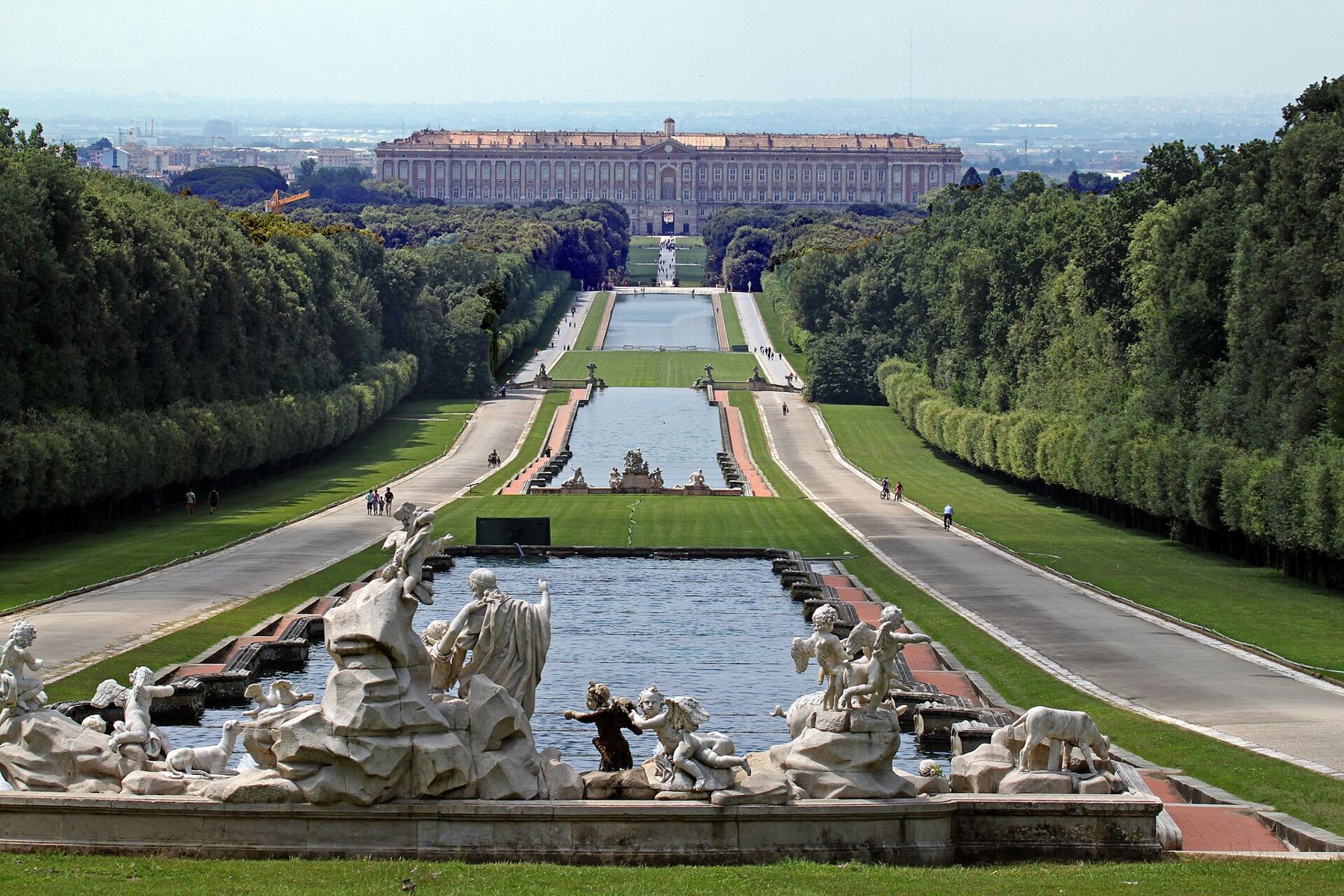
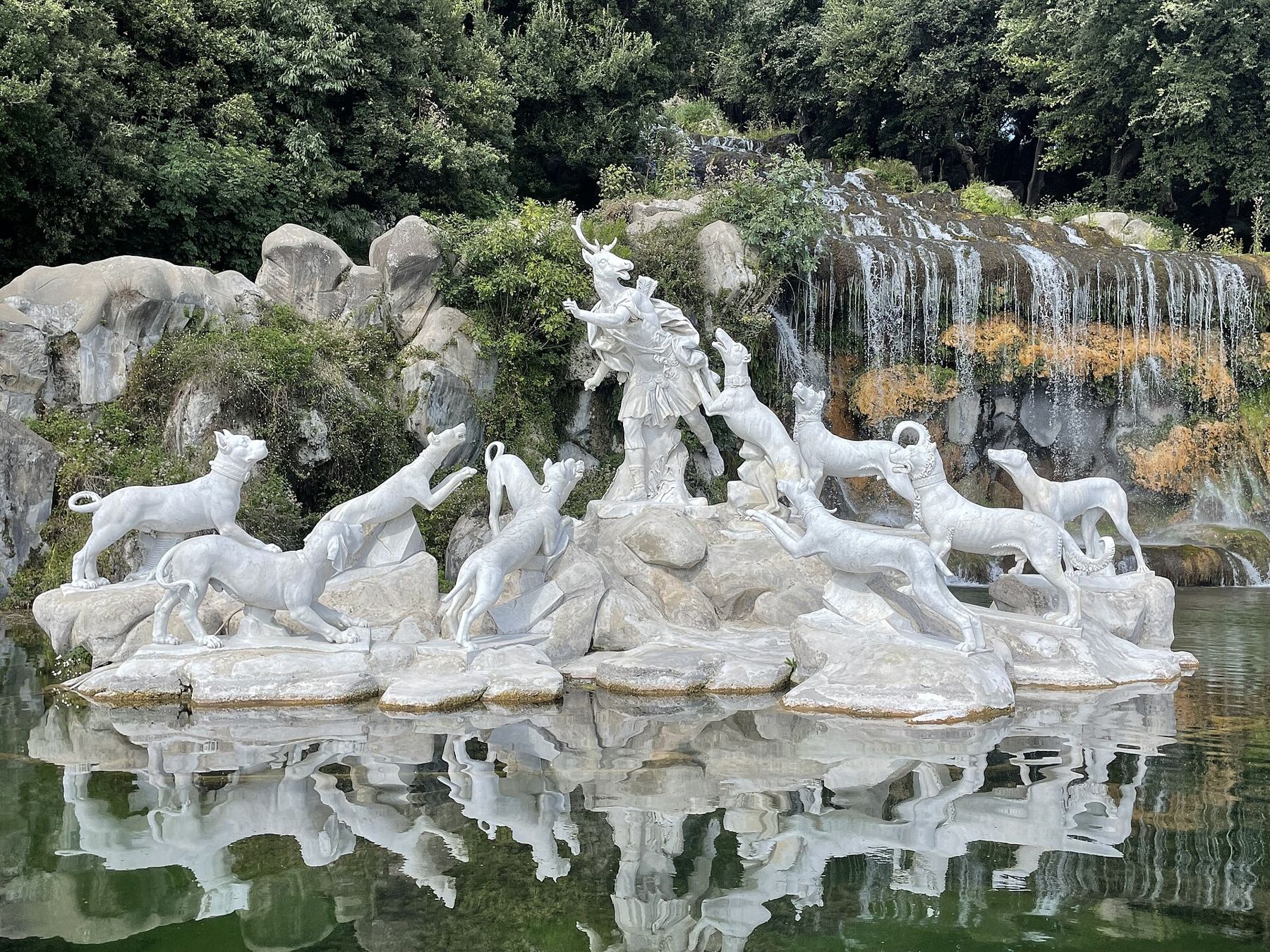
Behind the palace, the park runs in a straight line uphill for about three kilometres. Down its centre, a series of long pools, fountains and cascades, fed by an aqueduct built for the purpose, carries the eye to a great waterfall at the top. The pools are set at different levels, so that the water steps down the slope towards the palace, and the paths beside them are lined with clipped trees and wide lawns. Each fountain has sculpture from classical mythology: dolphins, Aeolus and the winds, Ceres, Venus and Adonis. At the top, the Great Cascade falls from the hillside into a basin where sculpture groups show Diana bathing with her nymphs and the hunter Actaeon being turned into a stag.
44Walking the length of the park and back takes a couple of hours. Bicycles can usually be hired and a small shuttle bus runs along it in season. The view back down the park to the palace, from the top of the cascade, is the reward.
Beside the Great Cascade, the English Garden was laid out in the late eighteenth century for Queen Maria Carolina, in the informal, landscape style then fashionable. In contrast to the straight lines of the main park, it has winding paths, exotic trees, a lake with an island, artificial ruins and a small bath with a statue of Venus. It is quiet and shady, a pleasant place to rest after the long walk up.
Access to the English Garden may be by guided visit or at set times; check when you arrive.
It was meant to rival Versailles, and in scale it does.
The kings who lived here
Charles of Bourbon, who commissioned the palace, never lived in it: in 1759 he left Naples to become King of Spain, and the building was completed under his son Ferdinand and later kings. For a century, the Reggia was one of the residences of the Bourbon kings of Naples, and later of the Two Sicilies, until the kingdom was absorbed into a united Italy in 1861. The Savoy kings of Italy used it occasionally, and it became state property in the twentieth century.
In the last weeks of the Second World War, the palace served as the headquarters of the Allied forces in the Mediterranean, and in April 1945 the surrender of the German forces in Italy was signed here. It has since appeared in many films, its staircase and corridors standing in for palaces real and imagined.
The aqueduct that feeds the fountains
The fountains of the park needed a large and steady supply of water, and Vanvitelli built an aqueduct more than thirty kilometres long to bring it from springs in the mountains. At one point it crosses a valley on a great three-tiered bridge of arches, the Ponti della Valle, which is a separate excursion from the palace and part of the UNESCO site. Water still flows through it to feed the cascades.
The aqueduct also supplied a model silk-weaving community the Bourbons founded at San Leucio, on a hill near the palace, with houses for workers, a church and a factory. It too is part of the World Heritage listing and can be visited.
A day at the Reggia
Caserta is about forty minutes by train from Naples. Allow most of a day for the palace and park. Wear comfortable shoes and carry water, especially in summer, when the park is hot and exposed. From here, return to Naples for the royal palace in the city and Capodimonte. Opening hours, prices and park access change, so check them for Caserta before you go.
Bring food and water for the park: there is little shade on the long central avenue, and the walk to the cascade and back is longer than it looks from the palace windows.
A hat helps too.