Number 53, the last door on this list, is one of the oldest royal palaces in Europe still in use. It stands on the highest point of the old city of Palermo, where the Phoenicians, Romans and Arabs all built before it. In the twelfth century, the Norman kings of Sicily, descendants of adventurers from northern France who had conquered the island from its Arab rulers, made it their residence. They brought together the cultures of their kingdom, Latin, Greek and Arab, and the palace they built reflects all three.
Today the palace is the seat of the Sicilian Regional Assembly, one of the oldest parliaments in the world in spirit, and part of it is open as a museum. Together with the cathedral of Palermo, the churches of Monreale and Cefalù and other buildings, it forms the UNESCO World Heritage Site of Arab-Norman Palermo.
From outside, the palace is a mixture of periods. The oldest parts, including a massive square tower, date from the Norman era and earlier. Later rulers, especially the Spanish viceroys, added a long facade and courtyards. The building looks more like a fortress than a royal residence, its stone walls tall and plain.
Inside, the visit leads through a great courtyard surrounded by arcades on three levels, built in the Spanish period, to the Palatine Chapel on the first floor.
The Palatine Chapel
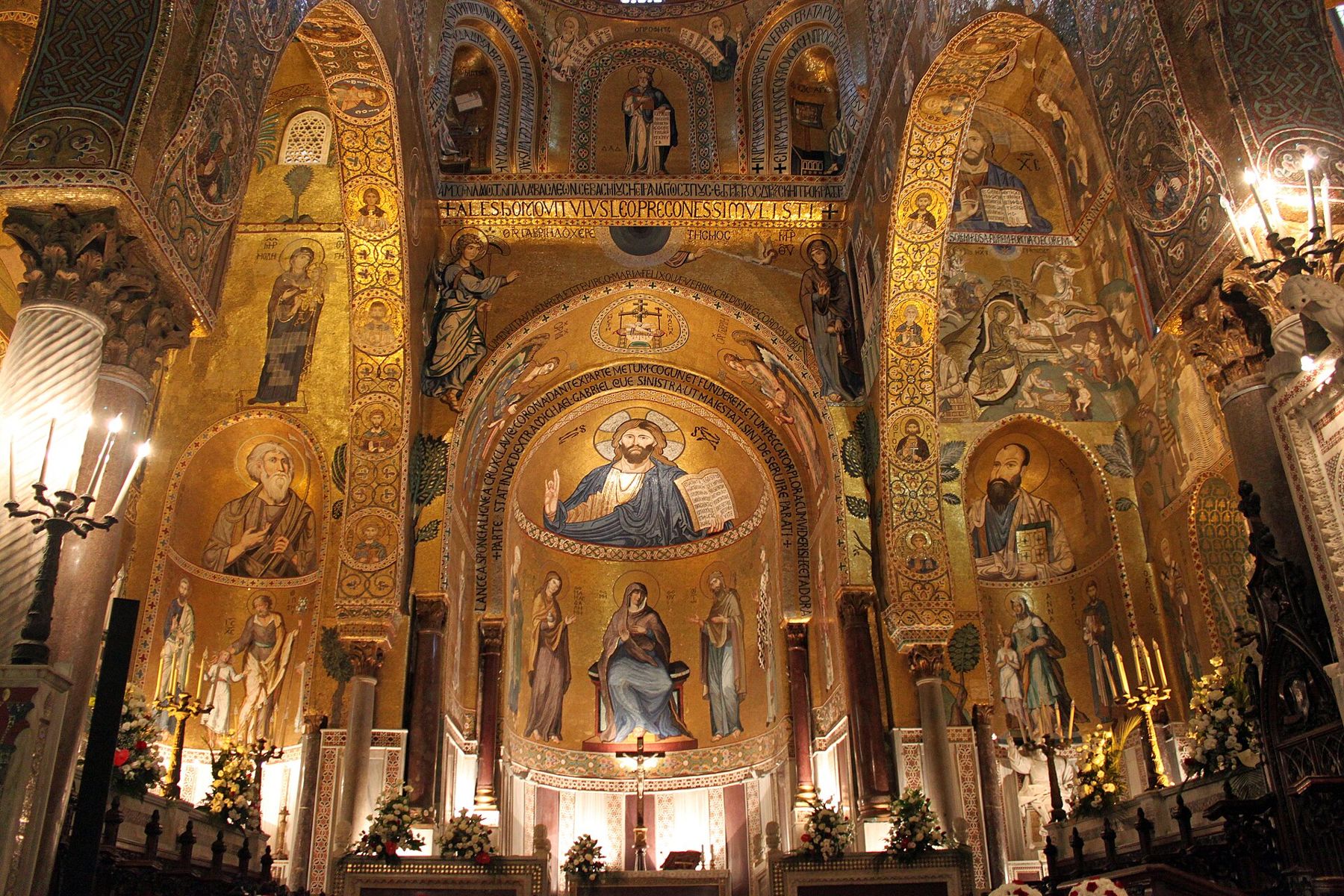
The Cappella Palatina was built for King Roger II and consecrated in the 1140s. It is one of the most extraordinary rooms in the world. The walls, arches and domes are covered with mosaics on gold backgrounds, made by craftsmen from the Byzantine world: Christ Pantocrator in the dome, surrounded by angels and prophets, and scenes from the Bible along the nave, with Adam and Eve, Noah's ark and the lives of Peter and Paul. When light enters through the windows, the gold glows.
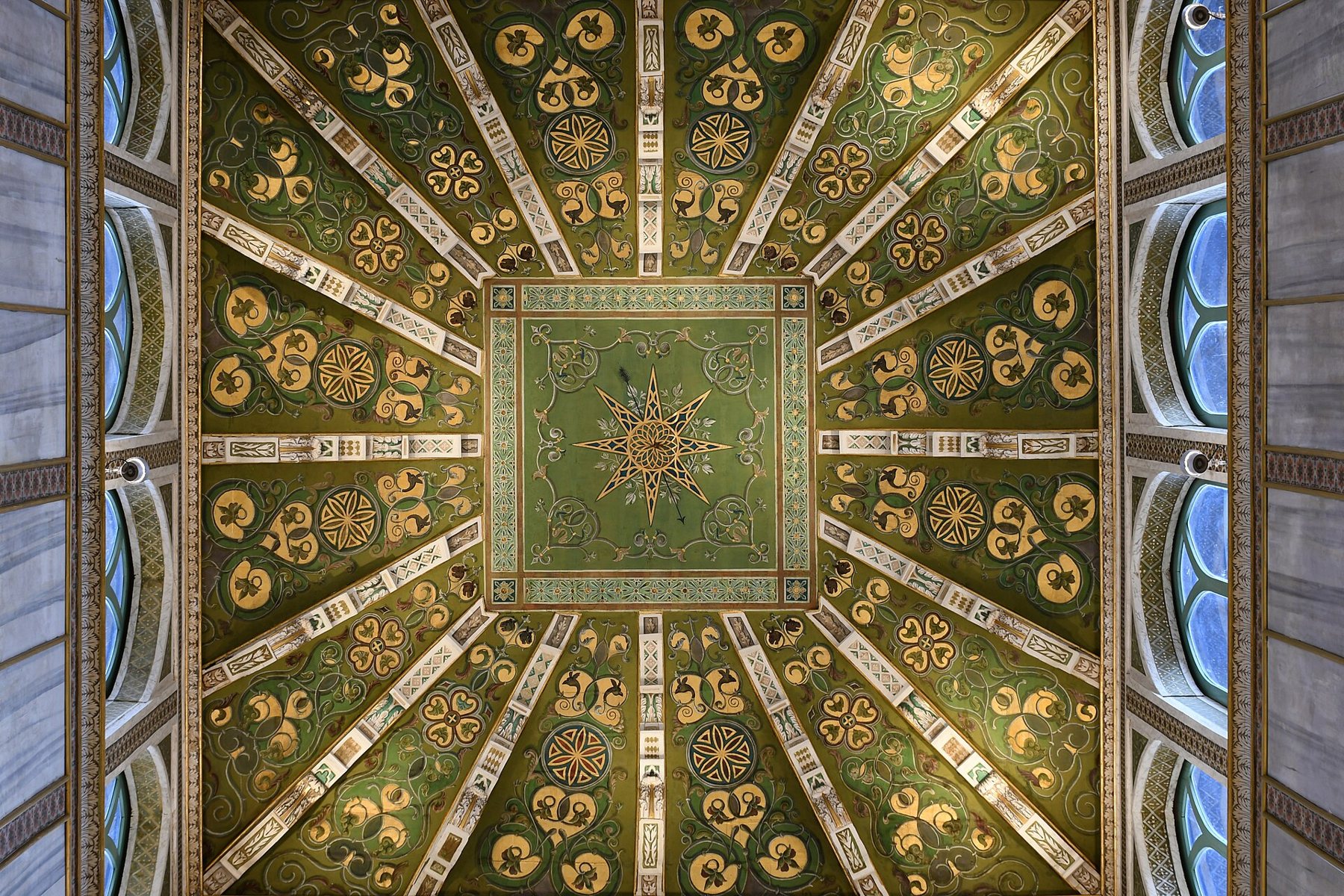
Above the nave, the wooden ceiling was made by Muslim craftsmen in the style of the Islamic world, with muqarnas, a honeycomb of carved and painted cells, decorated with scenes of court life: musicians, dancers, hunters, animals and drinkers. Inscriptions in Arabic script run around it. It is one of the largest surviving examples of Islamic painting from that period, and it sits above a Christian chapel built for a Norman king.
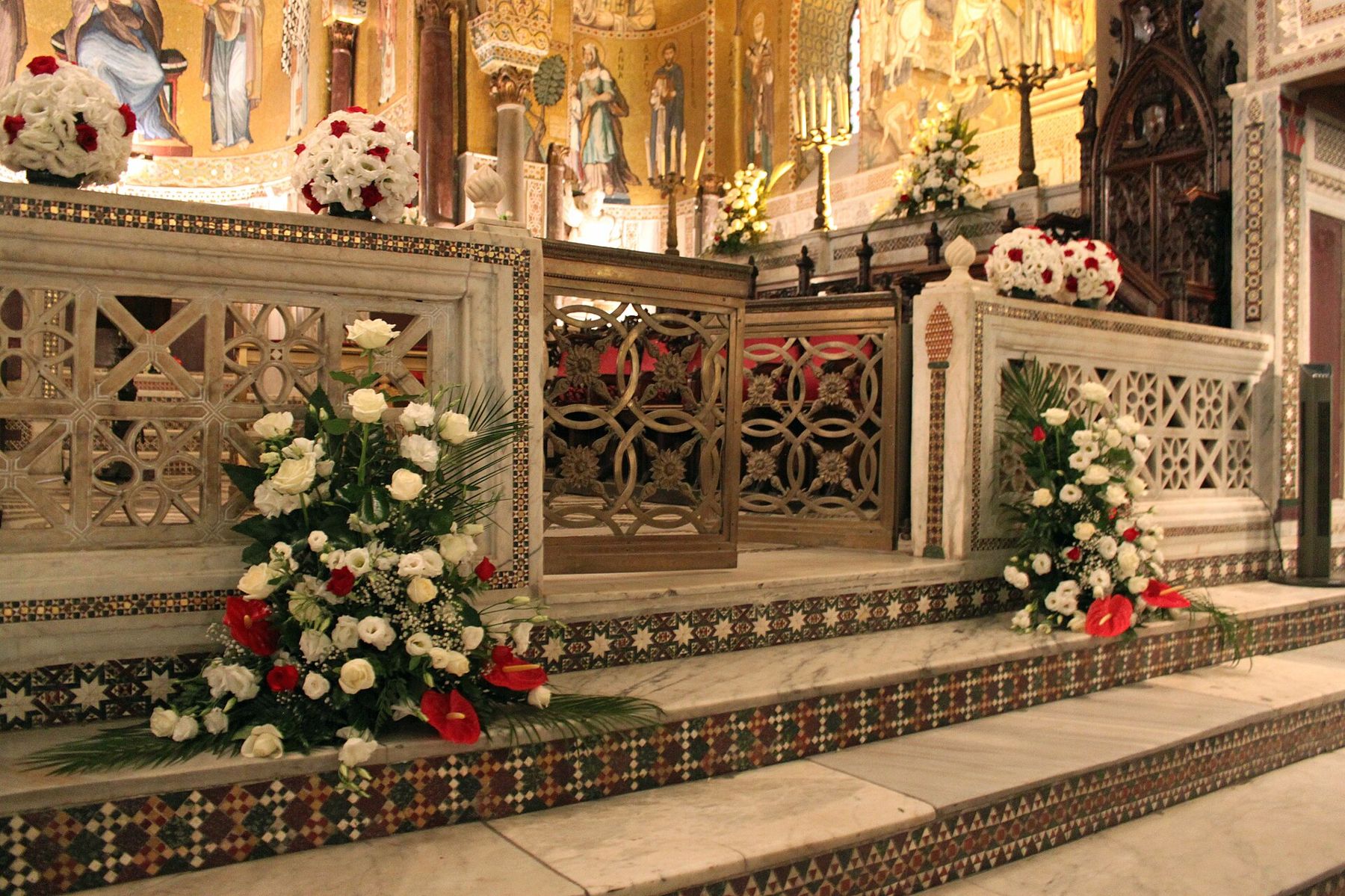
The floor and lower walls are covered in inlaid marble with geometric patterns, and a tall marble candlestick, carved with figures and animals, stands near the pulpit. The combination of Latin, Byzantine and Islamic art in one room is unique, and it reflects the mixed court of Norman Sicily.
King Roger's room and the royal apartments
On an upper floor, the room known as King Roger's room is decorated with twelfth-century mosaics of a different kind: hunting scenes, trees, peacocks, lions and leopards, on a gold ground, in a style that recalls the art of the Islamic world. It was a private room of the Norman kings, and its mosaics are secular rather than religious, one of the few such schemes to survive from that age.
50The visit also includes later royal apartments and the hall of the Sicilian parliament. Access to these rooms depends on the parliament's schedule; when the assembly is in session, parts of the palace are closed.
It is one of the most extraordinary rooms in the world.
The kingdom that built it
The Normans arrived in southern Italy in the eleventh century as mercenaries and soon became rulers. Count Roger, the first of the line, conquered Sicily from its Arab emirs, and his son, Roger II, was crowned king in 1130. Their kingdom was a meeting point of cultures: Arabic was spoken at court, Greek clergy served alongside Latin ones, and the kings employed Muslim, Byzantine and Latin artists and administrators.
That mixture is visible all over Palermo, in churches with red domes like those of mosques, in Arabic inscriptions on Christian buildings and in the gardens and pavilions built by the Norman kings. The palace is the centre of that story.
Visiting and dress
The chapel is a consecrated church, and visitors must dress modestly, with shoulders and knees covered. It may close during services. Queues can be long, especially in the morning and in high season, and tickets combine the chapel with other parts of the palace on some days and not on others. Check before you go, and arrive early.
Photography without flash is usually allowed, but the chapel is crowded and the light is low; the best way to see it is to stand still in the nave for a while and let your eyes adjust to the gold.
Gardens, towers and the view
The Norman kings surrounded Palermo with parks and pleasure palaces, inherited from the Arab emirs and enlarged. The palace itself had gardens and fountains, and the kings kept a park of exotic animals outside the walls. Little of that survives around the palace today, but the terraces and the upper rooms give views over the city to the mountains that ring the Conca d'Oro, the golden shell, the plain in which Palermo sits.
The palace's towers had different purposes: one was the treasury, another held the royal apartments, and the Pisan tower housed the royal treasure and an observatory was later built on top. The building has been changed so often that it takes some imagination to see the Norman palace inside the later shell, but the chapel and King Roger's room carry you straight back to the twelfth century.
Around the palace
The palace stands near the Porta Nuova, one of the old city gates, and close to the cathedral of Palermo, which holds the tombs of the Norman and Swabian kings. The church of San Giovanni degli Eremiti, with its red domes and a cloister garden, is a short walk away. The markets of the old city, especially Ballarò, lie just to the east. The list ends here, at number 53, but Palermo has other palaces worth a door of their own, such as Palazzo Abatellis in the Kalsa. For the first door on the list, go back to Genoa. Opening hours, prices and access change, so check them for Palermo before you go.
If the queue for the chapel is long, it usually moves steadily; the wait is short compared with the centuries of gold waiting inside. Combine the visit with the cathedral and the markets, and leave the afternoon for the Kalsa and its quieter palaces, where Palermo shows a different, later face.
Afterwards, the shaded gardens of Villa Bonanno beside the palace offer a bench and a view of its walls.