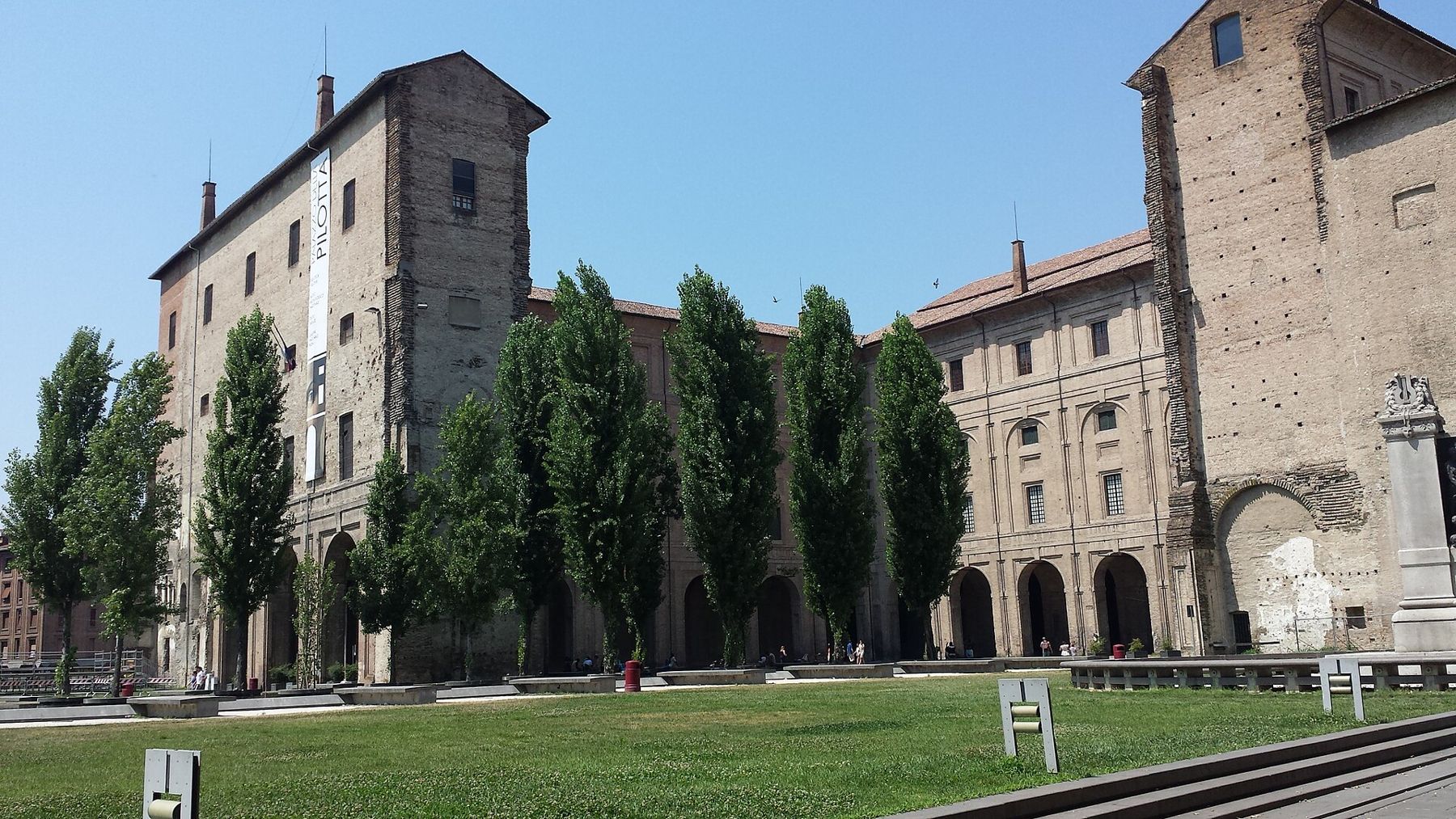
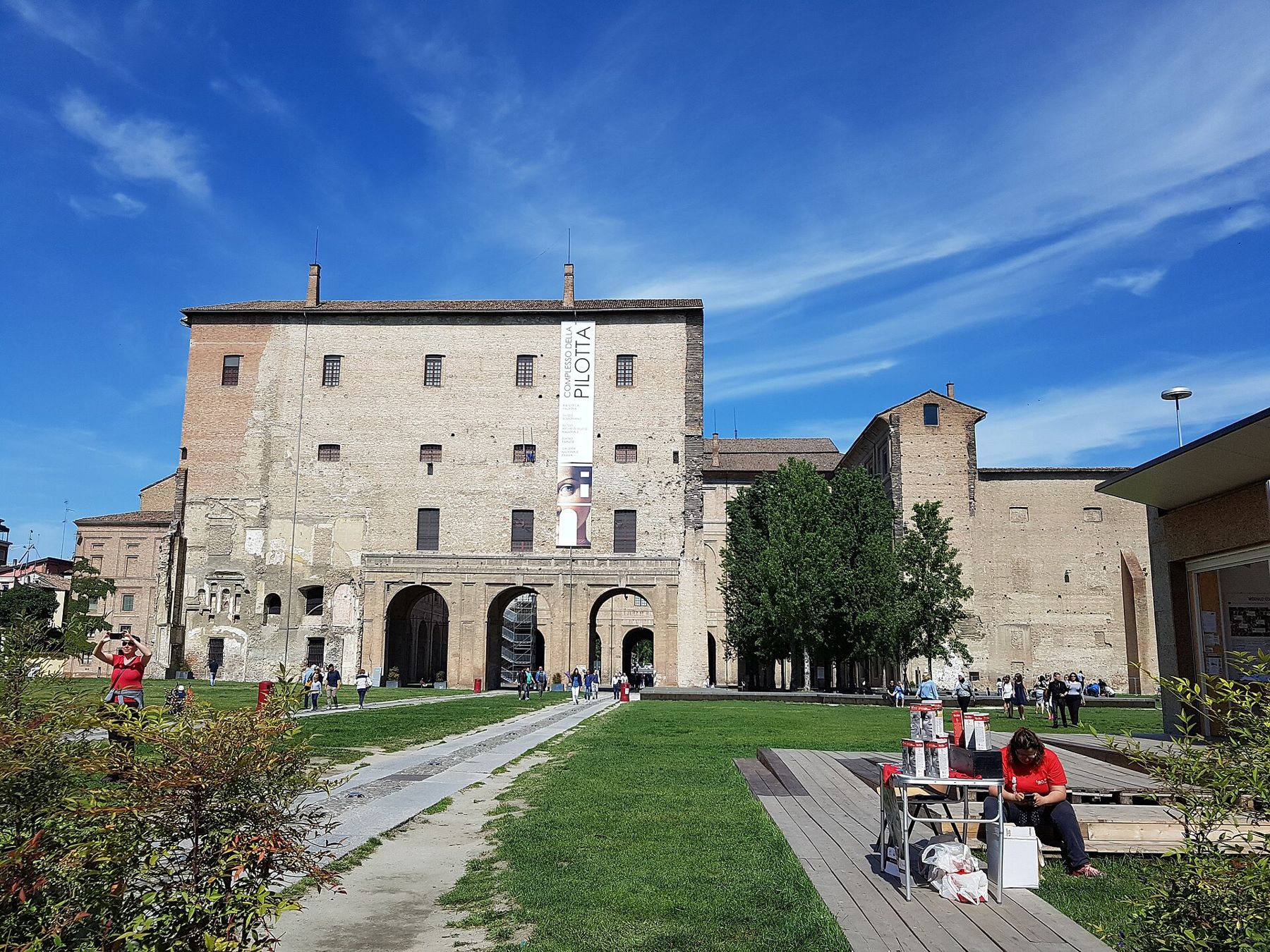
The Farnese family ruled the duchy of Parma and Piacenza from the sixteenth to the eighteenth century, and in Parma they built a vast complex of brick buildings beside the river to serve their court. It was called the Pilotta, probably after a ball game, pelota, played in one of its courtyards. Much of it was never finished, and its rough brick walls, with empty niches and unfinished surfaces, give it a severe, unpolished look from outside. It was also badly damaged by bombing in the Second World War.
Inside, though, the Pilotta holds some of the most remarkable spaces and collections in northern Italy. It is number 35 on this list.
The Teatro Farnese
The route through the Pilotta begins with its most extraordinary room. The Teatro Farnese was built in 1618 by the architect Giovanni Battista Aleotti inside a great hall originally intended for tournaments and ceremonies. Built almost entirely of wood, painted to look like marble and stone, it has a deep stage framed by an arch, and a U-shaped tier of steep wooden seats surrounding a large open floor. The floor could be flooded for staged naval battles.
The theatre was used only a handful of times for grand spectacles. It was severely damaged in 1944 and later rebuilt using surviving parts. Walking into it is an astonishing experience: a vast, silent space of pale wood, lit from high windows, with the empty seats rising around you. It is one of the earliest theatres with a permanent proscenium arch, the frame that separates the stage from the audience.
The National Gallery
From the theatre, the route continues into the National Gallery, which occupies a long series of halls in the complex. Its collection was built up from the Farnese and their successors, and it has outstanding works by the painters of Parma and Emilia. Correggio, who painted the great domes of Parma's cathedral and the church of San Giovanni, is represented by several paintings, and so is Parmigianino, the elegant and strange painter born in the city.
The gallery also has a small, unfinished head of a young woman attributed to Leonardo da Vinci, known as La Scapigliata, the dishevelled one. It is a quiet, intimate work, painted on a small wooden panel, and it is one of the most admired pieces in the collection. Later rooms of the gallery hold paintings from the Farnese and Bourbon periods, including works by Emilian painters of the seventeenth century, and a series of large canvases that once decorated the ducal residences. The long halls, with their bare brick and modern display, are themselves part of the experience.
The library and the printing museum
30The Palatine Library, founded in the eighteenth century, occupies a wing of the Pilotta, with long reading rooms lined with wooden shelves and painted ceilings. Parts of it can be visited at certain times. The complex also holds a museum dedicated to Giambattista Bodoni, the great type designer and printer who worked in Parma, with his typefaces, punches and books.
An archaeological museum in the complex displays finds from Roman Parma and from the ancient town of Veleia in the hills nearby, including a bronze tablet recording loans made by the emperor Trajan.
The Farnese and their collections
The Farnese family rose to power through the papacy: Alessandro Farnese became Pope Paul III in the sixteenth century, and he created the duchy of Parma and Piacenza for his son. The family built palaces in Rome, Caprarola and Piacenza as well as in Parma, and assembled one of the greatest art collections of the age, including ancient sculpture and paintings by Titian and other masters.
When the last Farnese duke died in the early eighteenth century, the duchy and the collection passed through his niece Elisabetta Farnese to her son Charles of Bourbon, who later became king of Naples. Charles took much of the collection with him to Naples, where it now fills the museums of Capodimonte and the archaeological museum. The Pilotta's own collection was rebuilt later, largely from the paintings of the Parma school and the churches of the region.
The emptiness of the great rooms, with their unfinished walls and long perspectives, is partly the result of that departure, and it gives the Pilotta a strange, haunting quality that suits the theatre at its heart.
Parma beyond the Pilotta
The Pilotta stands between the river and the old centre. A short walk east brings you to the cathedral and the baptistery, with Correggio's dome and the pink marble baptistery decorated with medieval sculpture by Benedetto Antelami. Across the river, the ducal park, the Parco Ducale, is a large public garden with a palace that was once the Farnese summer residence.
Parma is also famous for its food, especially its ham and cheese, and the city is known for its relaxed, well-kept streets.
Look out for the vast empty courtyards of the complex, used today as car parks and public space, which show how big the original plan was.
Hours, tickets, the right day
Parma is on the main railway line between Milan and Bologna, with frequent trains. Allow about two hours for the Pilotta. Some sections of the complex open and close in rotation, and the theatre can close for events. The list continues to Ferrara and south across the Apennines to Urbino. Opening hours, prices and access change, so check them for Parma before you go.