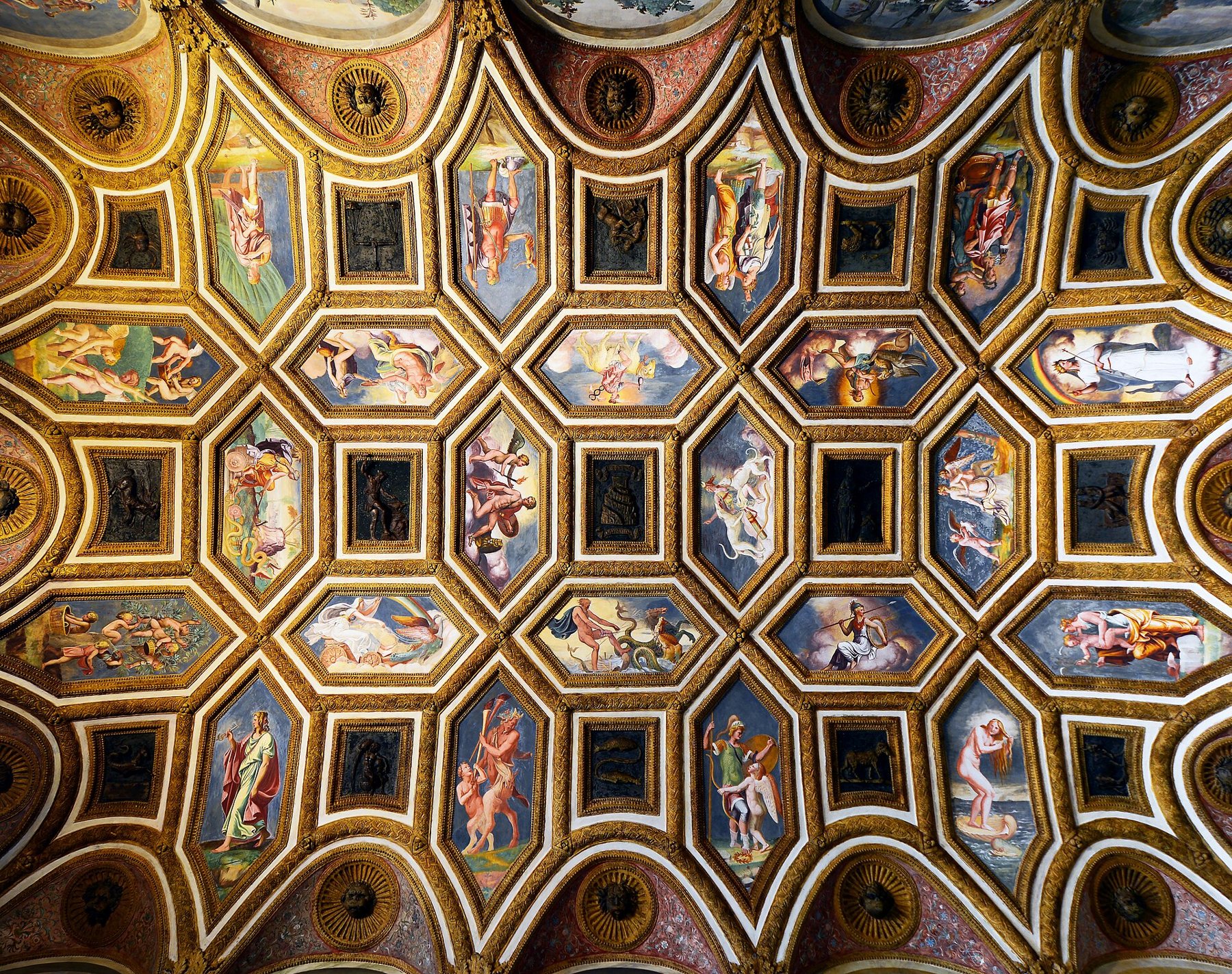
In the 1520s, Federico II Gonzaga, the young ruler of Mantua, wanted a place outside the city walls where he could escape the business of the court. On a marshy island at the southern edge of the city, where the family kept its horses, he asked his court artist, Giulio Romano, to build a villa. Giulio, a pupil of Raphael who had come north from Rome, designed the building and its decoration and directed a team of painters and stucco workers for about a decade. The result, Palazzo Te, is one of the most playful and theatrical buildings of the Italian Renaissance.
It is number 17 on this list, and it is a palace you go to for its rooms. From outside it looks low and square, almost plain. Inside, every room is a performance.
A villa that breaks its own rules
Palazzo Te is built around a square courtyard, with single-storey wings on all four sides. At first glance the architecture looks classical and correct, with columns, cornices and arches. Look closer and you notice that it is full of deliberate mistakes. In the courtyard, some of the stone blocks in the frieze above the columns seem to be slipping out of place, as if the building were about to fall. Keystones are too large, columns rest on unexpected bases, and rhythms are broken.
These were not errors. Giulio was playing with the rules of classical architecture for an educated audience who knew them well enough to enjoy the joke. The villa was a place for entertainment, and the building itself was part of the entertainment. Historians often use it as one of the first examples of the style later called Mannerism.
The horses and the room of Cupid and Psyche
The Gonzaga were famous breeders of horses, and one of the first great rooms honours them. In the Hall of the Horses, life-size portraits of the family's favourite horses stand in painted niches along the walls, each one an individual, between painted pilasters and statues. It is an unusual subject for a grand room, and an honest one: the horses were among the duke's proudest possessions.
The room of Cupid and Psyche is the most sensual in the villa. Its walls and ceiling tell the story of the love between the god Cupid and the mortal Psyche, ending with a vast wedding banquet that runs around the walls, full of gods, nymphs, satyrs and animals, with plenty of drinking and seduction. Federico used the villa to entertain his mistress, and the decoration of this room leaves little doubt about its purpose.
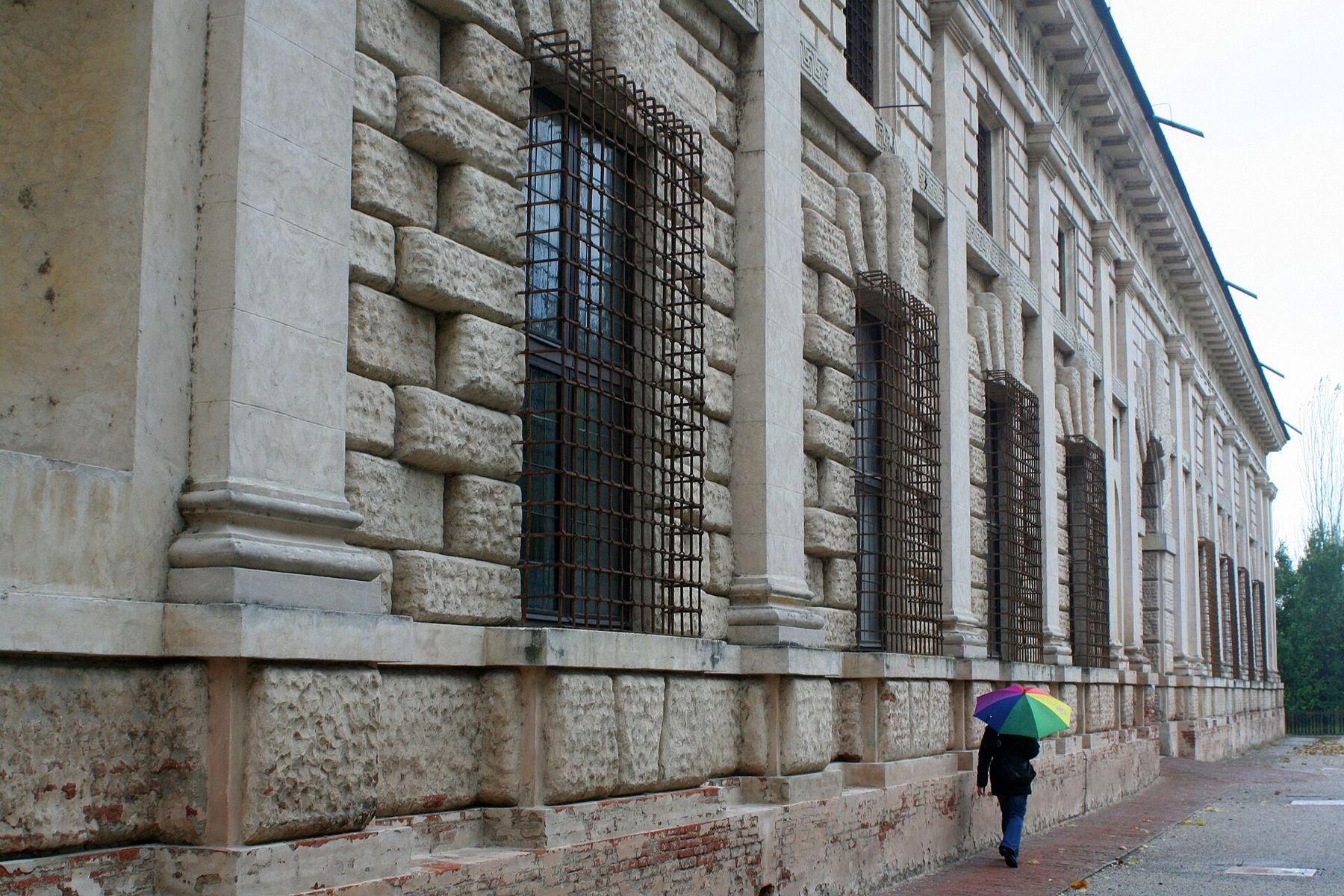
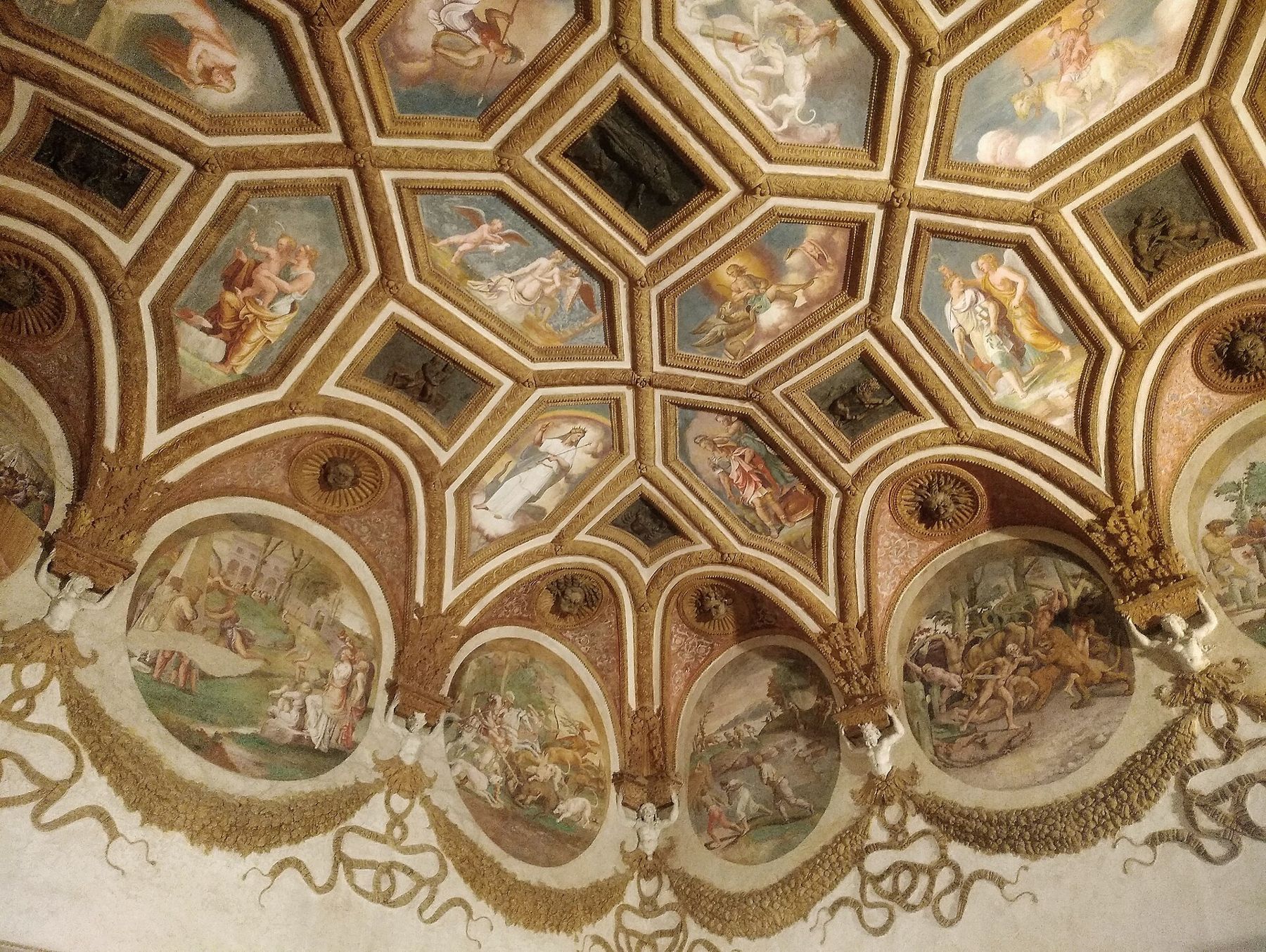
Look up too at the ceiling, divided into painted panels with scenes from the story seen from below, the figures foreshortened as if floating overhead. Smaller rooms between the great halls are decorated with painted friezes, stucco reliefs of Roman soldiers and astrological ceilings, among them the room of the winds, where the signs of the zodiac circle the vault. They are easy to walk through quickly, and worth not doing so.
The Chamber of the Giants
16The most famous room in the palace comes near the end of the visit. In the Chamber of the Giants, the painting covers every surface, walls and vaulted ceiling alike, with no frames or borders. It shows the moment from classical myth when Jupiter hurls thunderbolts at the giants who rebelled against the gods. Above, the gods watch from the clouds around Jupiter's throne. Below and all around, the giants are crushed by collapsing columns, falling rocks and tumbling buildings.
Standing in the middle of the room, you are surrounded. The corners of the room are disguised, the floor was once covered with pebbles to continue the scene, and the walls seem to be falling in on you. The effect is still overwhelming, and it was meant to be: visitors were supposed to feel the terror of the giants and the power of the ruler who commissioned it.
The garden and the grotto
Behind the main block, the villa opens onto a large garden enclosed by a curved wall, an exedra, at its far end. It was laid out as a formal garden, and today it is a quiet lawn with paths, a good place to sit after the intensity of the rooms. At one corner, a small apartment includes a grotto and a secret garden decorated with shells and stucco, a reminder of the villa's role as a retreat.
The garden also gives the best view of the building's long garden facade, with its loggia of arches opening onto the fishponds and lawns. Seen from here, the villa looks calm and orderly, the opposite of the rooms you have just walked through.
Exhibitions and the city
Palazzo Te is now a museum and exhibition centre, and it holds collections from the city's museums alongside temporary exhibitions in some of its rooms. Its upper floor has displays of Egyptian and Mesopotamian objects and other collections. Check what is showing before you go, as exhibitions can change the route and the time you need. The villa is busiest at weekends and on public holidays; on a weekday morning outside the summer, you may have the Chamber of the Giants almost to yourself for a minute or two, which is the best way to feel its effect. Photography without flash is usually allowed, but no photograph prepares you for standing inside it.
The villa, which takes its name from the old island of Tejeto on which it was built, sits at the southern edge of Mantua, about twenty minutes on foot from the cathedral and the ducal palace. The walk takes you through the city's quieter southern streets. Mantua is surrounded on three sides by lakes formed by the Mincio river, and the views across the water are part of the pleasure of a visit.
From outside it looks low and square, almost plain. Inside, every room is a performance.
Pairing it with the ducal palace
A visit to Palazzo Te pairs naturally with the Gonzaga's main palace in the centre of town, where Mantegna's painted room offers a very different kind of illusion, calmer and more intimate. Seeing both on the same day shows how the court's taste changed in half a century. Mantua and nearby Sabbioneta are together a UNESCO World Heritage Site. From here, the list continues to the lagoon and Ca' Rezzonico. Opening hours, prices and exhibitions change, so check them for Mantua before you go.
Leave time at the end to walk once more around the courtyard and look again at the slipping stones in the frieze.