Naples was for centuries one of the largest cities in Europe and the capital of a kingdom that covered the whole south of Italy. Its rulers changed many times, from Spanish viceroys to Austrian governors, Bourbon kings, a brother-in-law of Napoleon and finally the Savoy kings of Italy. Most of them lived in the Royal Palace, on the edge of the old city above the harbour, and each left something behind.
The palace was begun at the start of the seventeenth century by the architect Domenico Fontana for the Spanish viceroy, and it was extended and redecorated by later rulers. It is number 44 on this list, and the most central of the four Bourbon palaces of the Naples area.
The facade and its eight kings
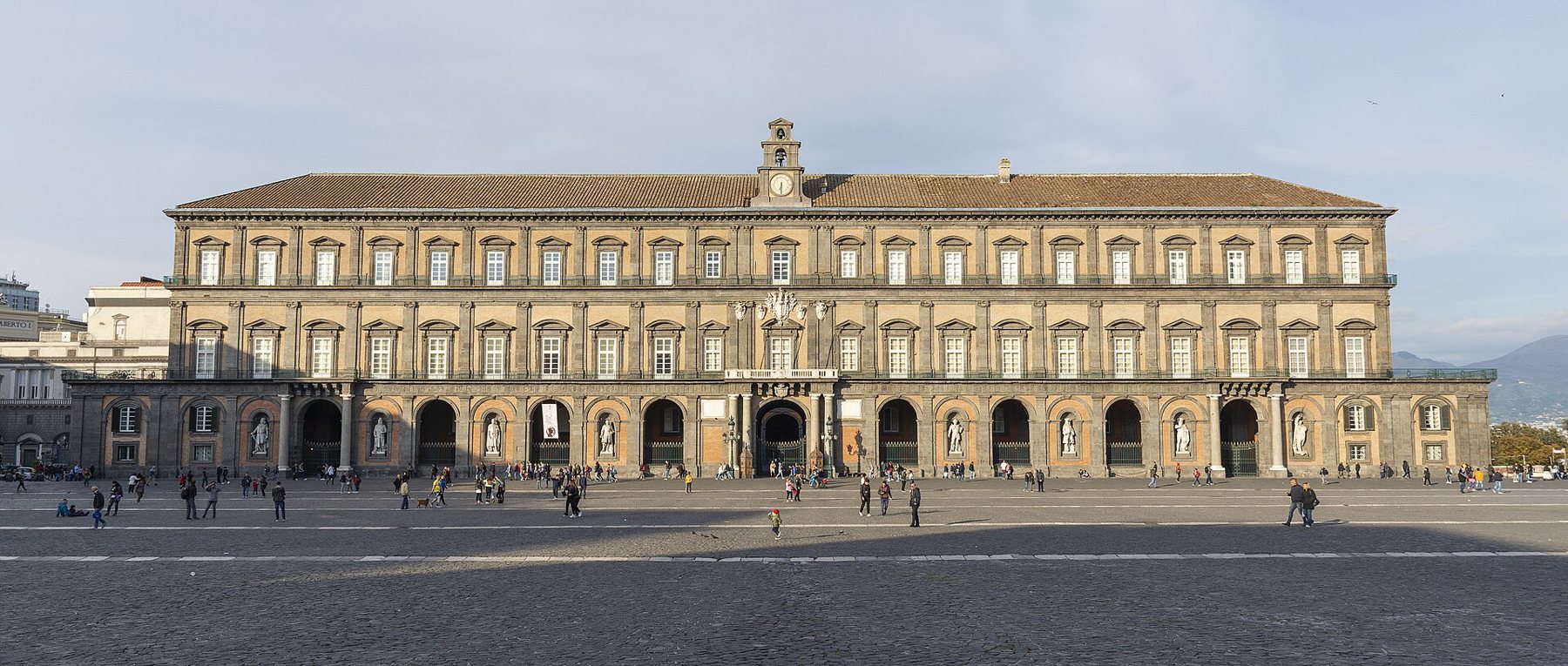
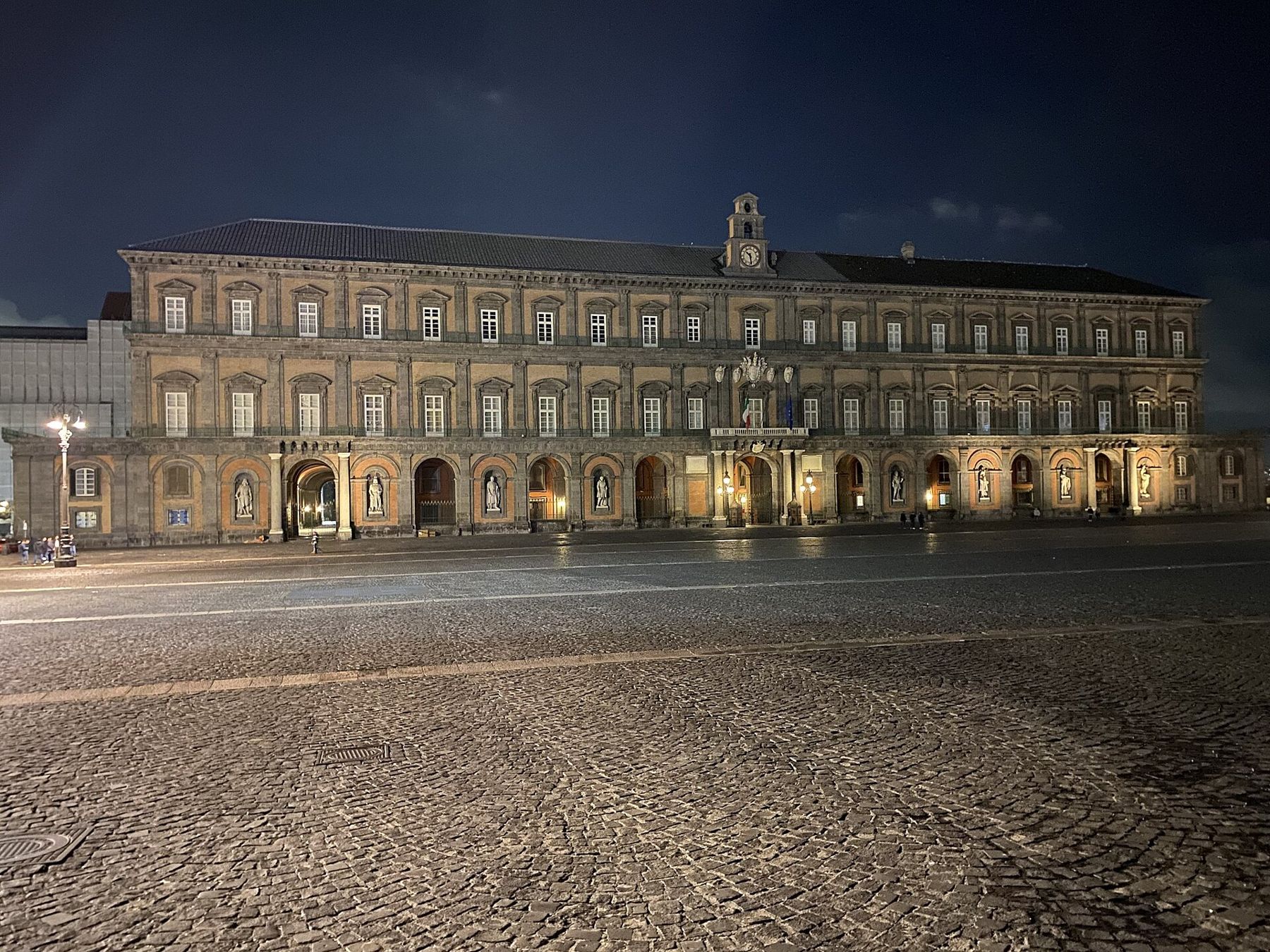
The palace's long main facade faces Piazza del Plebiscito, the great semicircular square closed on the other side by the domed church of San Francesco di Paola and its curving colonnade. The facade is two storeys of arcades and windows in red and grey, with a clock and a bell tower above the centre. At street level, a row of niches holds eight large statues of rulers of Naples, from the Norman Roger II to Victor Emmanuel II of Savoy, added at the end of the nineteenth century as a summary of the city's many masters.
The square in front was cleared of traffic in recent decades and is now a huge open space, often used for concerts and events. Children play in it, and on summer evenings it is full of people. Stand in the middle of the square, between the palace and the church, to take in the whole composition: the colonnade, the dome, the long facade and, beyond the palace, the slopes of the hills above the bay.
The grand staircase
Through the main gate, the courtyard leads to the grand staircase, one of the finest in Italy. Built in the seventeenth century and remodelled in the nineteenth, it rises in a single broad flight to a landing and then divides in two, under a vaulted ceiling. Its walls are faced with marble of many colours, and statues stand in its niches. It was designed to impress ambassadors and courtiers on their way to the king, and it still does.
The Court Theatre
At the top of the stairs, one of the first rooms on the route is the Court Theatre, built in the eighteenth century for the Bourbon court. It is a small, intimate theatre, with a horseshoe of seats and boxes, decorated with gilded papier-mache statues of the Muses and other figures. The court enjoyed opera and music, and performances were held here for the royal family and guests. The theatre was damaged in the Second World War and has been restored.
45Next door to the palace stands the Teatro di San Carlo, the great opera house of Naples, built by the Bourbons in the eighteenth century and connected to the palace so that the king could reach his box directly.
The royal apartments
The route continues through the royal apartments, a long sequence of rooms on the main floor decorated in the eighteenth and nineteenth centuries. They include throne rooms, ballrooms, a chapel, dining rooms and private apartments, furnished with gilded furniture, tapestries, porcelain, paintings and chandeliers. The decoration mixes the tastes of different rulers, from the heavy baroque of the Bourbons to the neoclassical style of the Napoleonic period.
Look out for the chapel, with its gilded altar, and for the painted ceilings with allegories of royal virtues. Many of the paintings come from the Bourbon collections.
On the sea side of the palace, a terrace garden laid out in the nineteenth century looks out over the harbour, the bay and Vesuvius. It is a quiet place among the trees and flower beds, with one of the best views in central Naples. On a clear day, the island of Capri appears on the horizon.
Rulers who changed the rooms
Every dynasty that ruled Naples redecorated the palace to suit itself. The Spanish viceroys built the core; the Bourbons, who arrived in the 1730s, made it a royal residence and filled it with the products of their own workshops, from tapestries to porcelain. During the Napoleonic period, Joachim Murat, Napoleon's brother-in-law, ruled as king and refurnished many rooms in the Empire style. When the Bourbons returned, they kept much of what he had done.
The result is a palace where a baroque ceiling may hang above Empire furniture, and a Spanish staircase leads to a Bourbon theatre. The labels in each room explain which ruler was responsible, and reading them as you walk is the best way to follow the story.
The National Library
Part of the palace houses the National Library of Naples, one of the largest in Italy, with manuscripts, early printed books and the carbonised papyrus scrolls found at Herculaneum, recovered from a villa buried by the eruption of Vesuvius in AD 79. The library has its own entrance and reading rules; some rooms can be visited, and exhibitions are held there from time to time.
Hours, tickets, the right day
Allow about an hour for the palace, more with the garden or an exhibition. The palace stands at the southern end of Via Toledo, the long shopping street of Naples, a short walk from the harbour and the Castel Nuovo. Combine it with Capodimonte on the hill above the city, or with a day trip to Caserta. Opening hours, prices and access to the garden change, so check them for Naples before you go.